
Engineering calculation guide
RC filter cutoff frequency: formula and worked example
For a simple first-order resistor-capacitor filter, the cutoff frequency depends on two values: resistance and capacitance. Here is the calculation, the unit check and a way to vary the values on an editable sheet.
Get the free offline calculatorThe relationship
Use the RC cutoff formula
For a first-order RC low-pass or high-pass filter, the cutoff frequency is fc = 1 / (2πRC). Here, R is resistance in ohms, C is capacitance in farads and fc is frequency in hertz. At the cutoff, the output magnitude is about 0.707 of the passband magnitude, or −3 dB.
This formula describes the ideal first-order circuit. A real design can also be affected by component tolerance, source and load impedance, and the rest of the circuit. Check those before treating a calculated value as a measured result.
Example: 10 kΩ and 10 nF
Convert the component values first: 10 kΩ = 10,000 Ω and 10 nF = 0.00000001 F.
fc = 1 / (2π × 10,000 × 0.00000001) ≈ 1,591.55 Hz, or about 1.59 kHz.
The product RC is 0.0001 seconds. The reciprocal has units of hertz; the 2π factor completes the cutoff calculation.
Work backwards
Choose a capacitor for a target frequency
If you already know the desired cutoff and have chosen a resistor, rearrange the formula: C = 1 / (2πRfc).
For a target near 1 kHz with a 10 kΩ resistor, the ideal capacitance is 1 / (2π × 10,000 × 1,000) ≈ 15.9 nF. An available standard capacitor value will usually differ from that ideal number. Put the actual value back into the first formula to see the resulting cutoff.
Changing R or C changes the cutoff in the opposite direction: doubling either value halves the ideal cutoff. That makes a sheet useful when comparing component choices.
Try the values
Keep the calculation on a reusable sheet
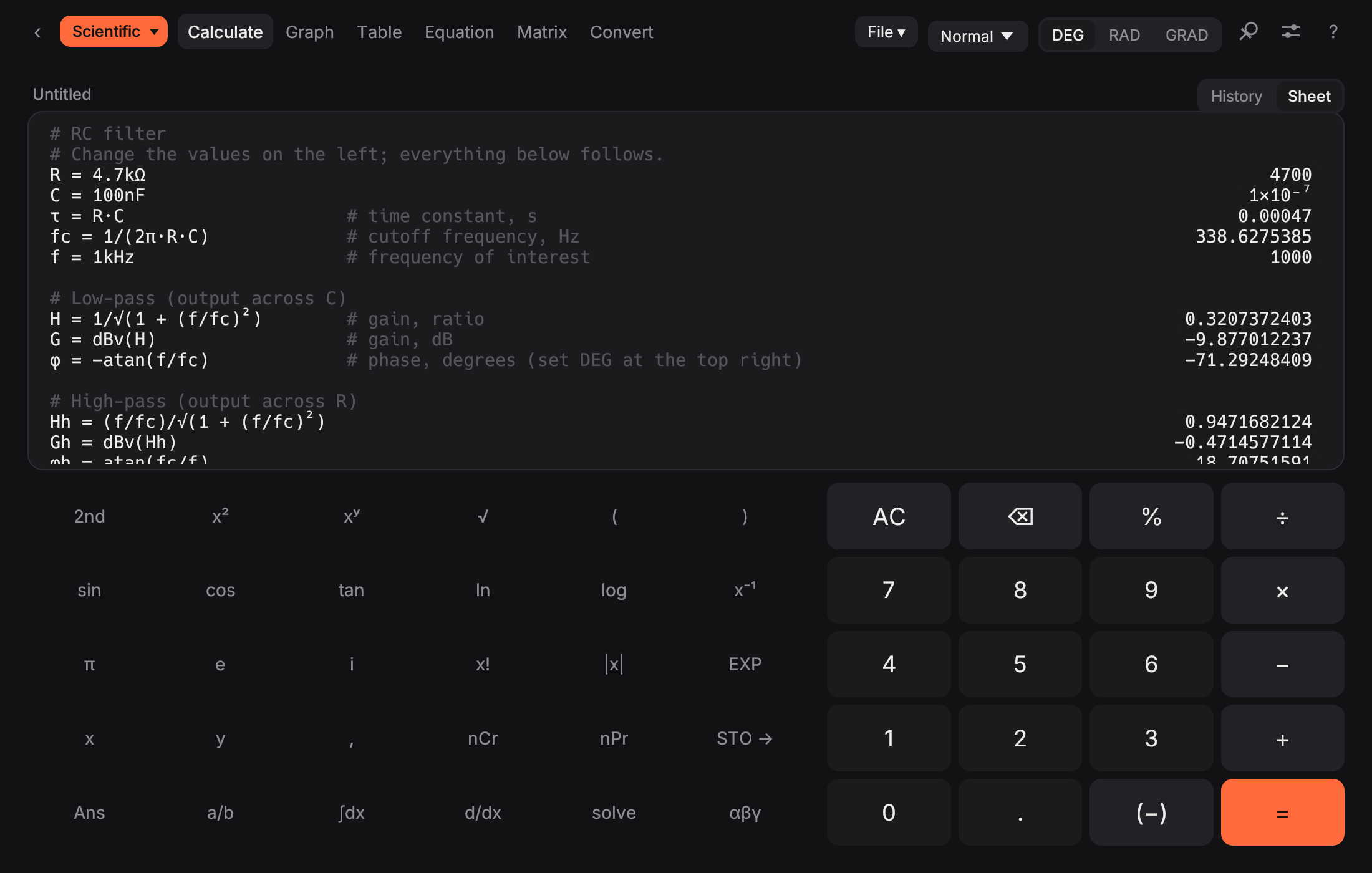
Sope's free Scientific Calculator includes an editable RC Filter worked sheet. The app's sheet view lets you name values such as R and C, calculate fc = 1/(2π·R·C), and change a value to update the calculations that follow. Save the sheet as a plain text .calc file to revisit the design.
Three checks before using the result
- Convert prefixes consistently. Confusing nF with μF changes the answer by a factor of 1,000.
- Use the actual component value. The nominal value printed on a part may differ from an ideal design target.
- Keep the circuit model in view. The formula above is for a simple first-order RC filter, not every active or multi-stage filter.
The calculator runs offline on macOS, Windows and Linux. Its download section lists the current packages and platform instructions.